Key Takeaways
- 3I/ATLAS, the third known interstellar comet, reached perihelion on Oct. 29, brightening rapidly as it passed behind the sun.
- Spacecraft like GOES-19 and SOHO have continued tracking it, even while it’s hidden from Earth-based telescopes.
- The comet’s unusual speed and age hint at its origins outside our solar system — possibly billions of years older than the sun.
3I/ATLAS Slips Behind the Sun, But Eyes Remain on It
Interstellar comet 3I/ATLAS (C/2025 N1) briefly disappeared from view this week as it looped around the sun, reaching its closest point — perihelion — on October 29. While the comet was obscured from Earth’s perspective, astronomers didn’t lose sight of it. Instead, they turned to solar-monitoring spacecraft to continue observing the cosmic traveler’s journey.
The comet, first spotted in July 2025, is only the third confirmed interstellar object to pass through our solar system, following ʻOumuamua (2017) and 2I/Borisov (2019). What sets 3I/ATLAS apart is its brightness, massive size, and record-breaking velocity — hurtling through space at over 130,000 mph (210,000 km/h).
Amateur Astronomers Join the Chase
Among those watching closely is Worachate Boonplod, a veteran comet hunter who detected 3I/ATLAS in GOES-19 weather satellite data earlier this month. Using the satellite’s CCOR-1 instrument, typically used for solar observation, Boonplod identified the comet glowing with a magnitude of around 11 — visible to sensitive telescopes but still far beyond the reach of the naked eye.
“The comet is moving from left to right relative to the background stars,” Boonplod wrote on the Comets Mailing List forum, noting that it remained visible to the satellite until October 24.
Other spacecraft, including NASA’s Solar and Heliospheric Observatory (SOHO) and the upcoming PUNCH mission, have been capturing additional data. SOHO’s LASCO C3 coronagraph, which blocks sunlight to reveal faint objects nearby, tracked the comet until October 26 — providing crucial insights into how it brightens as it approaches the sun.
Rapid Brightening Reveals the Comet’s Fiery Transformation
In a study published on Oct. 28 via the preprint server arXiv, researchers reported that 3I/ATLAS underwent rapid brightening just before perihelion, possibly reaching magnitude 9. While still faint for the human eye, this brightness indicates intense gas emissions — a hallmark of comets heated by solar radiation.
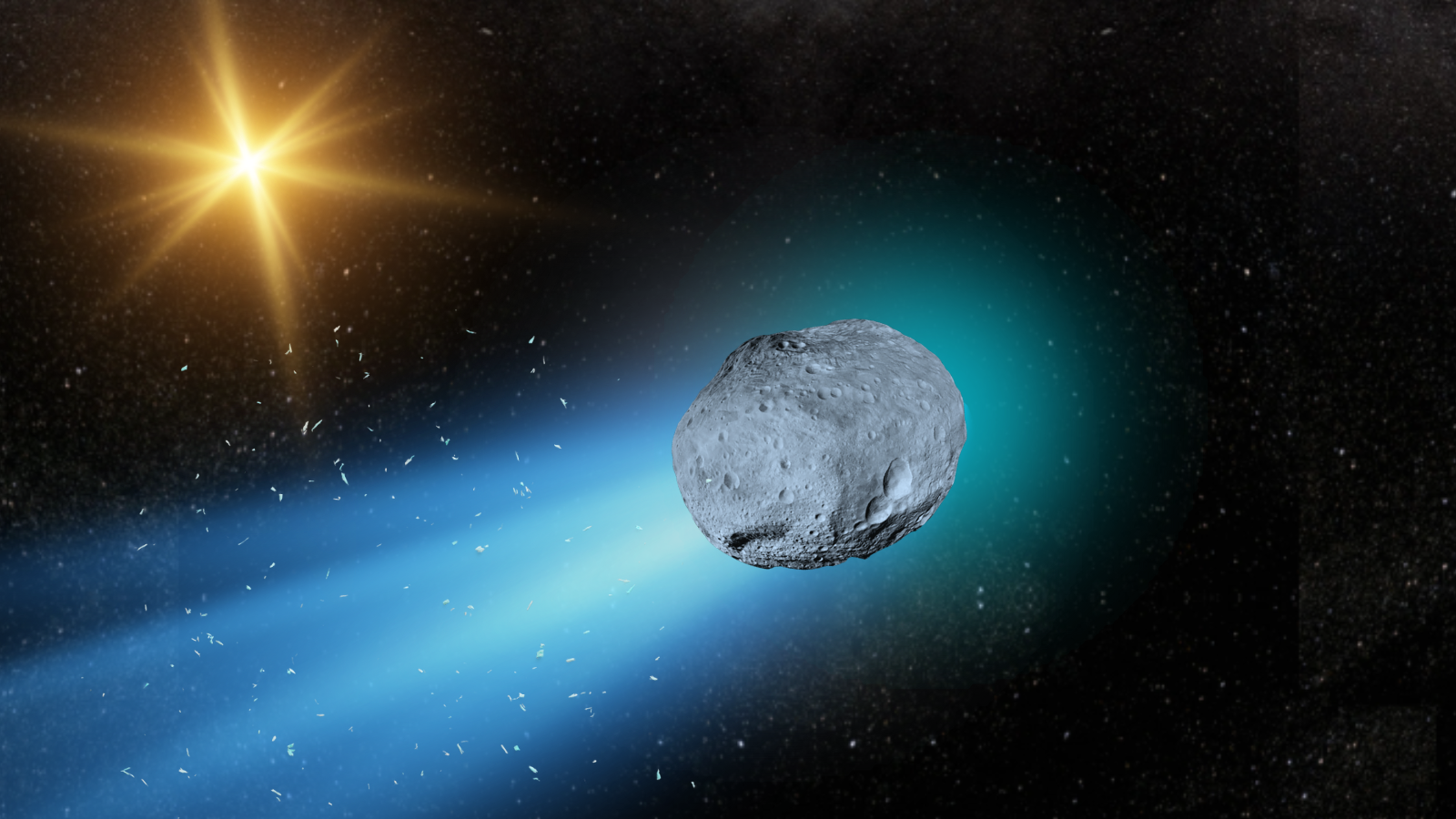
As 3I/ATLAS neared the sun, its surface ices sublimated, releasing gas that formed a luminous tail. The process caused the comet to appear bluer than the sun in spectral data, confirming that ionized gas was contributing significantly to its glow.
“Comets behave like cosmic time capsules,” said one researcher familiar with the observations. “By studying their composition, we get a glimpse into the materials that existed long before our solar system formed.”
An Ancient Visitor from Beyond the Stars
NASA’s analysis suggests that 3I/ATLAS could be older than our 4.6-billion-year-old solar system — possibly by another three billion years. This makes it one of the oldest and fastest visitors ever recorded. Hubble Space Telescope data estimates its maximum width at 3.5 miles (5.6 km), making it potentially the largest interstellar object ever seen.
Despite wild online speculation about alien origins, scientists affirm that 3I/ATLAS is a natural body — an ancient space rock flung from another star system after a gravitational encounter.
What’s Next: Visibility Returns in December
Although the comet is currently hidden behind the sun, NASA predicts it will reappear in early December, when it becomes observable again through Earth-based telescopes. Later, in March 2026, 3I/ATLAS is expected to pass near Jupiter, potentially visible to spacecraft orbiting the gas giant.
For now, the interstellar wanderer continues its silent journey — a fleeting reminder of how vast and interconnected the universe truly is.
Conclusion
The temporary disappearance of 3I/ATLAS around the sun hasn’t stopped astronomers from learning more about it. Using satellites like GOES-19 and SOHO, they’re piecing together the story of a cosmic traveler older than our solar system, blazing through space at impossible speeds. When it reappears later this year, 3I/ATLAS promises to offer even more insights — and perhaps a final, dazzling display before vanishing into the depths between the stars.